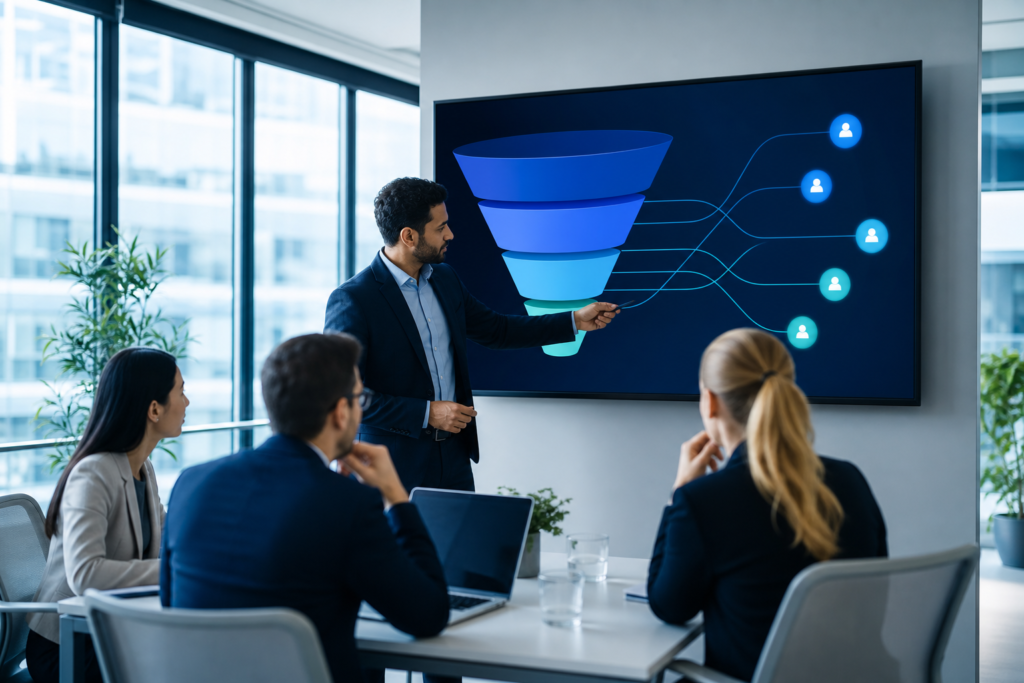
A strong B2B lead generation funnel does more than bring in traffic. It creates a structured path that turns strangers into qualified prospects and, eventually, into sales conversations. For B2B companies, that structure matters because buying decisions are rarely immediate. Prospects research, compare, evaluate, and often involve multiple stakeholders before they ever speak to sales.
This guide breaks down the complete B2B lead generation funnel from traffic to sales. You’ll learn how each stage works, what content and channels fit best, and how to improve conversions without relying on guesswork. Whether you are building a new funnel or fixing an existing one, the goal is the same: attract the right audience, earn trust, and move leads through a clear buying journey.
What Is a B2B Lead Generation Funnel?
A B2B lead generation funnel is the process of attracting potential business buyers, capturing their interest, qualifying their need, and guiding them toward a sales-ready conversation. It is called a funnel because many people may enter at the top, but only a smaller number progress to the bottom.
Unlike consumer funnels, B2B funnels usually take longer and depend more on education, trust, and relationship-building. A prospect may first find your brand through search, read a blog post, download a resource, attend a webinar, or request a demo. Each interaction should help them move one step closer to a decision.
Think of the funnel as a system, not a single campaign. Traffic alone does not create pipeline. The real value comes from the journey you design after the click.
The Core Stages of the B2B Lead Generation Funnel
Most funnels can be grouped into four practical stages: awareness, interest, qualification, and sales conversion. Some companies add more layers, but these four stages are enough to build a strong foundation.
1. Awareness: Attract the Right Traffic
The top of the funnel starts with traffic. At this stage, your goal is not to sell immediately. It is to make sure the right people discover your brand in the first place.
Common traffic sources for B2B lead generation include:
- Search engine optimization and content marketing
- Paid search and paid social campaigns
- LinkedIn outreach and advertising
- Webinars and virtual events
- Referral traffic and partner content
- Industry directories and comparison pages
The key is relevance. High traffic volume is not useful if it comes from people outside your target market. A focused B2B lead generation funnel should attract decision-makers, influencers, and researchers who match your ideal customer profile.
2. Interest: Capture Attention with Useful Offers
Once a visitor arrives, you need a reason for them to take the next step. This is where landing pages, lead magnets, and strong calls to action matter.
Examples of useful B2B offers include:
- Industry guides and white papers
- Checklists and templates
- Case study summaries
- Webinar registrations
- Product demos or consultation requests
- ROI calculators or assessment tools
At this stage, your content should solve a problem or answer a question. If the offer feels too generic, people will leave without converting. If it is too sales-focused, they may hesitate. The best offers sit between the two: practical, specific, and valuable.
3. Qualification: Separate Curiosity from Intent
Not every lead is ready for sales. Some are early-stage researchers. Others may not fit your ideal customer profile. Qualification helps you identify which leads deserve more attention.
Qualification can be done through:
- Form fields that capture company size, role, or need
- Behavior tracking, such as page visits and downloads
- Lead scoring based on engagement
- Manual review by marketing or sales teams
Good qualification protects your sales team’s time and improves follow-up quality. It also helps marketing understand which channels and offers produce better leads, not just more leads.
4. Sales Conversion: Turn Leads into Conversations
Once a lead is qualified, the objective shifts from education to action. Sales conversion may mean booking a discovery call, scheduling a demo, requesting a proposal, or starting a procurement conversation.
To support this stage, your funnel should include:
- Clear next-step CTAs on landing pages and emails
- Fast response times from sales teams
- Relevant follow-up based on the lead’s behavior
- Case studies, testimonials, or proof points that reduce risk
In B2B, the sales stage is often collaborative. A single lead may need internal approval before moving forward. Your funnel should make it easy for them to explain your value to other stakeholders.
How to Build a B2B Lead Generation Funnel Step by Step
Now that the stages are clear, here is how to build the full system in a practical way.
Step 1: Define Your Ideal Customer Profile
Before spending on traffic, define exactly who you want to attract. A strong funnel starts with clarity about the industries, company sizes, decision-maker roles, pain points, and buying triggers that matter most.
Ask questions such as:
- Which companies are the best fit for our solution?
- What business problem are we solving?
- Who is involved in the decision?
- What objections might stop a purchase?
Without this clarity, your funnel may generate leads that look active but never convert into revenue.
Step 2: Create Content for Each Funnel Stage
Different buyers need different information at different times. A complete B2B lead generation funnel includes content mapped to the buyer journey.
| Funnel Stage | Buyer Need | Best Content Types |
|---|---|---|
| Awareness | Understand the problem | Blogs, guides, SEO pages, short videos |
| Interest | Evaluate solutions | Webinars, comparison pages, case studies, lead magnets |
| Qualification | Assess fit and readiness | Assessments, pricing pages, demos, consultation pages |
| Sales | Choose a provider | Proposals, testimonials, tailored presentations, follow-up emails |
Content should answer questions before a prospect asks them. The more friction you remove, the easier it becomes for leads to keep moving.
Step 3: Build Landing Pages That Convert
Your landing pages should have one clear goal. Do not overload them with too many choices. A high-performing page usually includes a strong headline, a short value-driven explanation, proof of relevance, and one primary action.
Effective landing page elements include:
- A clear promise or benefit
- Simple form fields
- Trust signals such as reviews, logos, or certifications where appropriate
- Visuals that support the offer
- A call to action that matches the prospect’s intent
For example, someone downloading a guide should not be forced into a sales-heavy conversation immediately. Someone requesting a consultation, however, should see a more direct path to contact.
Step 4: Set Up Lead Nurturing
Most B2B leads are not ready to buy on the first interaction. Lead nurturing bridges that gap. It keeps your brand top of mind while providing useful information that builds confidence over time.
A nurturing sequence may include:
- A welcome email after the first conversion
- Educational follow-up emails
- Relevant case studies or use cases
- Product or service comparison content
- Invitations to book a consultation or demo
Good nurturing is not about sending more emails. It is about sending the right message based on where the lead is in the decision process.
Step 5: Qualify Leads for Sales
Marketing and sales should agree on what makes a lead qualified. That alignment prevents wasted time and improves pipeline quality.
A simple qualification framework may look like this:
- Fit: Is the company and contact a good match?
- Need: Does the lead have a problem you solve?
- Engagement: Have they interacted with key content or pages?
- Timing: Is the lead exploring a solution now or later?
When qualification is consistent, sales can prioritize outreach and marketing can focus on the channels that create the best opportunities.
Step 6: Optimize the Handoff to Sales
A funnel breaks when leads reach sales and nothing happens. The handoff must be fast, structured, and personalized.
To improve the handoff:
- Send lead context with the inquiry
- Route leads to the right team member
- Set response time expectations
- Use sales messaging based on the lead’s interests
This is where many B2B funnels lose momentum. A lead who downloads a resource may forget your brand within days if nobody follows up in a relevant way.
What Makes a B2B Lead Generation Funnel Effective?
Not every funnel performs equally. The most effective ones share a few common traits.
Clear Messaging
Your audience should quickly understand what you do, who you help, and why it matters. If the message is unclear, the funnel leaks at every stage.
Strong Alignment Between Marketing and Sales
Marketing should drive qualified interest. Sales should know how that interest was generated and what problem the lead is trying to solve.
Relevant Offers
Offers work best when they feel useful and specific to the buyer’s stage. A generic lead magnet rarely performs as well as a focused resource that addresses a real pain point.
Consistent Measurement
You cannot improve what you do not measure. Track traffic, conversions, lead quality, nurture engagement, and sales outcomes together, not separately.
Continuous Testing
Small changes can have a large impact over time. Test headlines, landing page structure, form length, CTAs, and email follow-up to learn what moves leads forward.
Common Mistakes in B2B Lead Generation
Many B2B teams struggle because the funnel is built around activity rather than conversion.
- Too much focus on traffic: More visitors do not matter if they are the wrong visitors.
- Weak offer strategy: If the incentive is not compelling, people will not convert.
- Poor lead qualification: Sales teams get overloaded with low-intent leads.
- No nurturing: Leads disappear when they need time and education.
- Slow follow-up: Interest fades quickly without timely outreach.
- Disconnected reporting: Teams measure clicks, leads, and sales separately instead of looking at the full picture.
A well-built B2B lead generation funnel reduces these issues by connecting traffic generation, conversion design, and sales follow-up into one system.
How OneCode Pulse Supports B2B Lead Generation
For businesses that want a more strategic funnel, OneCode Pulse can help build the digital foundation needed for growth. That may include high-performance websites, lead-generating landing pages, CRM integration, marketing automation, SEO, and analytics-driven optimization.
Because B2B growth depends on more than one channel, the most effective systems combine strategy, technology, and execution. OneCode Pulse works with startups, businesses, and organizations that want secure, scalable, and measurable digital solutions aligned with long-term growth goals.
If you need support improving your funnel, you can explore OneCode Pulse for broader services or contact the team for a free consultation to discuss your lead generation goals.
FAQs About the B2B Lead Generation Funnel
How long does a B2B lead generation funnel take to work?
It depends on the complexity of your offer, your sales cycle, and your traffic quality. Some businesses see early traction within weeks, while others need more time to build content, test messaging, and refine nurturing.
What is the difference between a lead and a qualified lead?
A lead has shown interest, such as by filling out a form or downloading content. A qualified lead has been assessed and appears more likely to become a customer based on fit, need, and engagement.
Do I need both marketing and sales automation?
Not always, but automation can improve consistency. Marketing automation helps with nurturing and lead scoring, while sales automation can support follow-up, routing, and pipeline management.
Which channel is best for B2B lead generation?
There is no single best channel for every company. Search, LinkedIn, email, paid media, webinars, and referral partnerships can all work depending on your audience and offer. The best approach is usually a mix of channels tied to one funnel.
How do I know if my funnel is underperforming?
Look for weak points such as low conversion rates, poor lead quality, slow sales follow-up, or a drop-off between lead capture and sales meetings. Those signals show where optimization is needed.
Conclusion: Build a Funnel That Moves Traffic to Sales
A successful B2B lead generation funnel is not just about attracting attention. It is about guiding the right people from traffic to trust, from trust to qualification, and from qualification to sales.
When each stage is aligned, your funnel becomes easier to measure, improve, and scale. Start with a clear audience, create useful content, build high-converting landing pages, nurture leads thoughtfully, and make the sales handoff seamless.
If you want help building or improving your B2B lead generation funnel, contact OneCode Pulse for a free consultation. Our team can help you create a secure, scalable, and performance-focused system designed for long-term growth.